
Who am I in Egypt?
My name is Stephanie Amin, and I am a 25-year-old Egyptian woman, a child of the 25 January 2011 revolution. I was 15 when the revolution began. At that time, I was studying literature and history in the French section of a Catholic school in Heliopolis. My history teacher, Madame Corine Rochesson, shared fascinating stories about the French revolution, and I vividly remember watching political analysis on TV comparing the two revolutions. I was afraid that our revolution would be equally violent.
While the revolution was a defining moment in my political awakening, it wasn’t the first. My political awareness began to develop in 2008, following the 6 April protests and the general strike in the working-class city of Mahalla. Workers, particularly those in the textile industry, protested against rising prices, low wages, delayed bonuses, and the privatization of public-sector firms from 2005 to 2007.
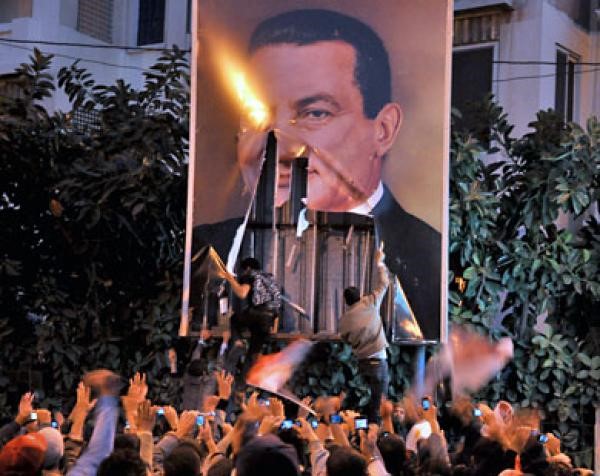
Mubarak’s banner photo torn during the 6 April protests. (Photo: Al Jazeera uncredited).
I recall seeing images of Mubarak’s portraits being torn down during the 6 April protests. Until then, his pictures were displayed with reverence in classrooms and on the cover of the Egyptian history book. Witnessing that moment had a profound impact on me.
Unfortunately, the 6 April protests did not lead to political change. As a teenager, I developed a sense of cynicism, feeling that change would never come. Then came 25 January 2011. On that day, while celebrating my sister’s birthday at Chili’s in Heliopolis, I acted like an expert political analyst, stating that nothing significant would happen and the protests would be crushed, similar to what occurred in 2008.
The revolution’s main slogan was “Bread, Freedom, and Social Justice” (Eish, Horreya, ‘Adala Igtema’eya). I wholeheartedly embraced this slogan and began taking a keen interest in public issues. I found that my political views aligned with left-wing parties and social movements.
Before the revolution, my family and I lived in a bubble, disconnected from the majority of Egyptians. Our socio-economic status afforded us privileges such as attending private schools, participating in sports clubs, and visiting beaches. Despite frequent attacks on Copts, even during Mubarak’s regime, most Copts held conservative political positions and were content with whatever the state offered.
That bubble burst after the Maspero massacre on 9 October 2011. Following attacks on a church in Aswan, Coptic protesters gathered around Maspero, the state television service building in downtown Cairo. The massacre resulted in the loss of 28 lives, including 25 protesters and 3 security forces. One of the victims was Mina Daniel, a member of the Justice and Freedom movement. Mina was passionate about Che Guevara and even started dressing like him, as his sister Mary recounts. It was the first time I saw a Copt live and die for the revolutionary ideals he believed in. Mina fought for equal citizenship as an Egyptian first and a Copt second. As a socialist, he focused on Egypt’s impoverished population.
Mina Daniel’s story inspired me. I wanted to honor his sacrifice. Although I come from a privileged background, I felt compelled to continue his fight and champion equal citizenship. Mina’s example motivated me to reconcile my Coptic identity with my left-wing political ideology. Thanks to Mina, I discovered that I could be a Coptic Christian, Egyptian, and Arab simultaneously.
In 2019, I made the decision to leave for France to pursue my master’s degree. I expected my stay there to be longer due to the unwelcoming political and social climate in Egypt.
First bar in Paris
I enrolled in political sociology at Paris 1 Panthéon-Sorbonne and quickly found myself immersed in a new environment.
Shortly after my arrival, I was invited to a classmate’s birthday party. I was eager to meet new people and engage in stimulating political discussions. However, during a conversation outside the bar with some of my classmate’s friends, I introduced myself as Stephanie from Egypt. Their puzzled expressions made it clear that I needed to explain why an Egyptian had a European name. This was not the first nor the last time I encountered such a situation. My name carried assumptions about my religious affiliation, class privilege, and international upbringing.

I always have this meme in mind whenever I must explain my name and background.
As we spoke, one of the guys mentioned that he had written a paper on Egyptian politics the previous year. We discussed various aspects of the situation in Egypt. After about 40 minutes of sharing my disappointment with current events, another guy asked, “So, do you support the current regime?” The person who had written about Egyptian politics answered on my behalf, saying, “Duh, she’s Coptic. She definitely does.” This assumption reinforced long-held stereotypes without considering my own words and the sentiments I expressed throughout our conversation.
The Long History of the Christians of the Orient
In France, the term “Christians of the Orient” has a lengthy history. According to Claire Lefort-Rieu, the expression originated after the persecution of Maronites by the Druze, which culminated in the 1860 Mount Lebanon massacre in Syria. This event mobilized European public opinion and led political leaders to send military and humanitarian aid to the Christians. Bernard Heyberger further explains that these incidents were interpreted as a “Muslim, Druze, and Ottoman conspiracy against Christianity.” Unfortunately, this categorization perpetuates an “orientalist” tradition that reduces these minorities solely to their religious identity, disregarding “the variety of their ecclesiastic affiliations or their socio-political conditions”.
The concept of “Christians of the Orient” becomes more problematic when intertwined with French politics. This is evident in the case of SOS Chrétiens d’Orient, the organization on which Lefort-Rieu based her research. Founded in 2013 and with apparent links to the far-right, the NGO is currently under investigation for funding pro-Bashar al-Assad militias responsible for war crimes. By focusing exclusively on “helping and/or protecting” Christians of the Middle East, SOS Chrétiens d’Orient exploits Christian communities to advance its Islamophobic agenda. I find it difficult to accept that my identity could be associated with such an organization.
Who am I? Once again

Screenshot from Jean Valjean’s “Who am I” played by Hugh Jackman in the film Les Misérables
While writing this article, I couldn’t help but reflect on the song “Who am I” from the musical Les Misérables. The character Jean Valjean, a former convict who rebuilt his life, questions his own identity when he discovers that another man has been mistakenly arrested in his place. Through introspection, he tries to understand who he truly is and what he stands for.
I occupy a marginalized identity in my home country as a privileged Copt who embraces leftist ideals within the broader context of Egyptian and Arab society. This complexity becomes even more intricate when I decided to move to France—a different country with its own colonial history and preconceived notions about my homeland and region. Walking the streets of Paris, I am often reduced to just another Arab woman, subject to derogatory terms like “beurette” associated with Maghrebi origins.
It takes a conversation and someone knowing my name for them to understand that I am also a Copt. These categories are not mutually exclusive in my view. I consider myself fortunate to inhabit a space where different cultures and identities intersect. However, this marginal position goes beyond the sum of its parts. It is best theorized through the lens of intersectionality.
Intersectionality, a concept developed by African-American theorist Kimberlé Crenshaw in 1989, offers a framework to understand the complex dynamics of multiple marginalized identities. In her Demarginalizing the Intersection of Race and Sex: A Black Feminist Critique of Antidiscrimination Doctrine, Feminist Theory and Antiracist Politics, Crenshaw likens it to traffic in an intersection, where discrimination can flow in different directions:
“Consider an analogy to traffic in an intersection, coming and going in all four directions. Discrimination, like traffic through an intersection, may flow in one direction, and it may flow in another. If an accident happens in an intersection, it can be caused by cars travelling from any number of directions and, sometimes, from all of them. Similarly, if a Black woman is harmed because she is in the intersection, her injury could result from sex discrimination or race discrimination.”
In the anecdote at the bar, my political opinion was prematurely assumed based solely on my religious identity. However, intersectionality helps us grasp the intricate nature of grappling with multiple marginal identities. In Egypt, I am a Copt with left-wing views, and in France, I am also an Arab. These identities intersect and shape my experiences and perspectives.
For me, intersectionality is not a plea for victimhood or a mere compilation of marginal identities. This article is not a call from a defeated and vulnerable “Christian of the Orient.” On the contrary, it serves as an opportunity to expand our understanding of others. And so, the bar anecdote doesn’t end there. I quickly spoke up, explaining that my political opinions should not be assumed based on my religious background alone. I asserted my individuality and the right to hold my own beliefs. Despite media portrayals of Copts as a monolithic group with particular opinions, I am entitled to my own thoughts and convictions.
Being a “Christian from the Orient” in France in 2020 presents its challenges and complexities. It requires navigating societal expectations, countering stereotypes, and finding solidarity with diverse communities. I am continually shaping my identity, honoring my heritage, and embracing my political ideals.
Just as Jean Valjean in Les Misérables sought to understand his true self, I strive to define who I am, reconciling the various aspects of my identity. I refuse to be confined to a narrow box labeled by stereotypes or assumptions. Instead, I celebrate the richness that comes from embracing my intersecting identities as a Copt, an Egyptian, an Arab, and a believer in social justice.
By sharing my experiences and insights, I hope to foster a greater appreciation for the complexities of identity, challenge preconceived notions, and encourage a more inclusive and nuanced understanding of individuals like myself. In the end, we are all multifaceted beings, shaped by our unique journeys, and deserving of recognition and respect for the diversity that defines us.
Egypt Migrations is always looking for people to contribute to our digital initiatives. Please contact team@egyptmigrations.com if you would like to join or support the organization.
Stephanie Amin Interned with Egypt Migrations and is an Egyptian researcher and aspiring filmmaker. She holds a master’s degree in political sociology from Paris 1 Panthéon-Sorbonne. Her research interests focus on gender and its intersection with religion and class in contemporary Egypt.
 Egypt Migrations